
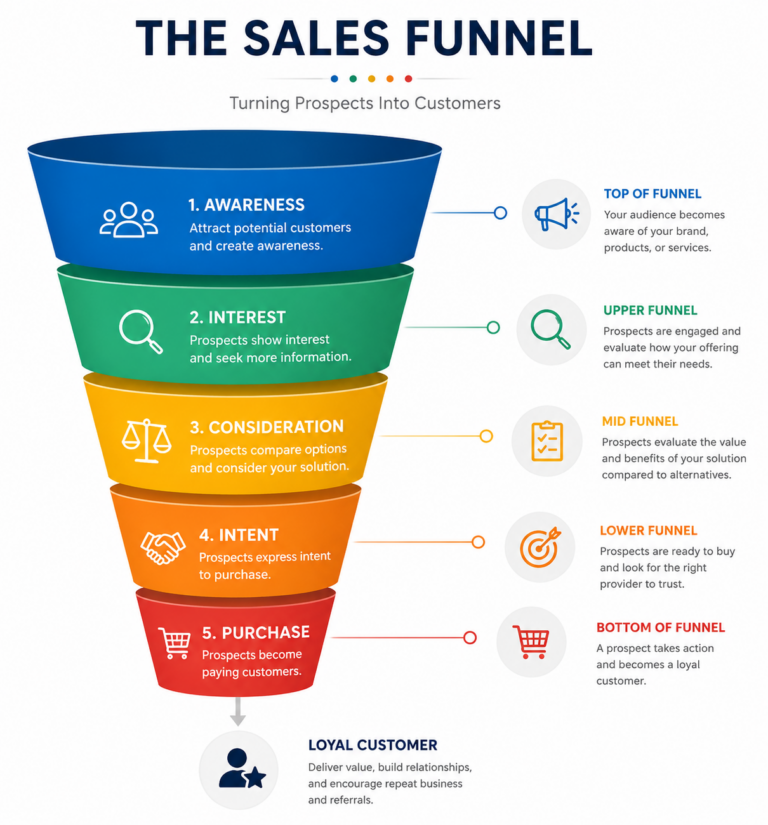
A sales funnel is simply the journey your customer takes, broken into stages you can see and improve. At the top, a wide group of people first notices you. In the middle, a smaller group raises a hand and shows interest. At the bottom, the people who trust you decide to buy. Sales Funnel Development is the work of designing each of those stages on purpose instead of hoping people figure out how to buy from you on their own.
The word funnel describes the shape of the journey, because more people enter at the top than reach the bottom. That narrowing is normal and healthy. Your job is not to force every visitor to buy. Your job is to help the right people move forward while gently filtering out the ones who were never a fit. When you treat a sales funnel creator mindset as a teaching role rather than a pushy sales role, your numbers tend to improve, because trust does most of the heavy lifting.
Here is the part many small business owners miss. A funnel is not a single web page or one clever ad. A funnel is a connected system of offers, messages, and follow-up that work together, and each piece has one purpose: move a person to the next step. Once you see your marketing as a series of small, logical steps, the whole process feels far less overwhelming.
Before you begin your sales funnel development, take inventory of what you already have. Most small business owners are sitting on more raw material than they realize. Your email list, your past customers, your case studies, your testimonials, your standard operating procedures, and the hard-won lessons in your head all count as assets. Strong sales funnel development starts with this honest audit, because the fastest funnel to build is usually the one that repackages knowledge you already own.
Your intellectual property deserves special attention. Intellectual property covers the original work your business creates, such as your unique method, your branded process, your written guides, your photos, and your proprietary checklists. When you write down the steps you take to get a result for a client, you turn invisible expertise into a visible asset you can sell, teach, or give away to attract leads.
As you take stock, ask a few simple questions about each asset. Does this solve a real problem? Could you explain this to someone in a short video or a one-page guide? Would a stranger pay to skip the trial and error you went through? The answers point you toward the offers worth building first. The U.S. Small Business Administration guidance on market research and competitive analysis can help you confirm that real demand exists before you invest your limited time.
Once you know what you own, look for digital products hiding inside that knowledge. A digital product is anything you create once and sell many times without shipping a physical item, such as an online course, an eBook, a template pack, a paid webinar, or a membership. These products carry strong profit margins because you do the work a single time, then sell the result again and again.
Picture a lawn care company that has answered the same questions about seasonal yard work for years. That same advice could become a short seasonal guide sold for a small price, or a free checklist that brings new leads into the funnel. A bookkeeper could turn a messy-to-clean spreadsheet process into a template buyers download in minutes. The pattern is always the same: find the repeatable result you deliver, then package that result so a buyer can reach the outcome faster. Digital products also feed the rest of your funnel, because a small first purchase often opens the door to larger offers later.
With your assets in hand, sketch the full path a customer travels, from first hello to repeat purchase. Strong sales funnel development depends on this map, because naming each stage keeps you from skipping the steps that build trust.
A typical journey moves through awareness, where someone discovers you; consideration, where they weigh their options; decision, where they buy; and retention, where they come back. When you can name the stage a person is in, you can hand them exactly the message they need next. Each stage should work to build and reinforce prospect trust.
The value ladder is the backbone of that journey. Picture a staircase of offers that climb from low cost and low commitment up to premium and high commitment. At the bottom step you might place a free guide or a low-priced digital product. The next step could be a core service or a mid-priced course. The top step holds your most valuable offer, such as done-for-you work or a high-touch program. Each step delivers a real win, which earns you the right to invite the customer up to the next step.
A value ladder matters for sales funnel development because most people will not start at the top. Asking a brand-new visitor to buy your most expensive package is like proposing marriage on a first date. Instead, you let a small, low-risk purchase prove your value, and that proof makes the next yes far easier. Done well, this approach raises your average customer value over time, because a single buyer can climb several steps rather than buying once and disappearing.
Every funnel needs a steady supply of new people at the top, so sales funnel development starts with lead generation architecture is how you create that supply. The core idea is an exchange: you offer something genuinely useful, and in return a visitor gives you permission to follow up, usually by sharing an email address. That free, valuable item is often called a lead magnet, and a strong lead magnet solves one specific problem quickly.
The mechanics are simple once you see them. You drive traffic from sources like search, social posts, referrals, or ads to a focused landing page. That page makes a single promise and asks for one action: enter your email to get the guide, the checklist, or the free training. After someone signs up, a thank-you page and a welcome email confirm the next step. A good sales funnel creator keeps this entry point clean, with no clutter and no competing links that pull attention away from the one action you want.
To keep your top-of-funnel healthy, focus on a short list of high-impact pieces rather than trying to be everywhere at once:
Each of these pieces works together to turn a cold visitor into a known contact you can nurture. Start with one traffic source you can sustain, prove that the page converts, and only then add a second source. Trying to master every channel at once is the fastest way to burn out, so steady beats flashy here.
In the middle of your funnel, you warm up interested people with offers that teach and sell at the same time. Webinar funnels, book funnels, and course funnels all do this job well. A webinar funnel invites people to register for a live or recorded training, delivers real value during the session, and then presents a related offer at the end. Because you taught something useful first, the offer feels like a natural next step rather than a hard pitch.
A book funnel works on a similar principle of generosity. You offer a low-cost or free-plus-shipping book that showcases your method, and readers who finish wanting more raise their hand for a bigger offer. A course funnel sells a structured learning experience directly, often supported by a short video series that builds trust before the buy button appears. Each of these middle-funnel paths shares a common rhythm: teach first, prove your value, then invite the person to go deeper.
The reason these funnels convert is psychological. When you give someone a genuine result before asking for money, you trigger a sense of reciprocity and you demonstrate competence at the same time. A person who already learned something from your free training has far less reason to doubt your paid offer. This is why teaching-based sales funnel development tends to outperform pushy tactics over the long run.
When your offer carries a high price or requires a close working relationship, an application funnel protects both your time and your prospect experience. Instead of a simple buy button, you invite interested people to apply for a spot through a short form or a booked call. That extra step filters out poor fits and signals that your work is selective and valuable.
An application funnel usually flows from a piece of content or a webinar into an invitation to apply. The application asks a few qualifying questions about budget, timeline, and goals, which lets you focus your energy on the people most likely to benefit. By the time you speak with a qualified applicant, both of you already know there is a strong match, so the conversation feels like a fitting next step rather than a cold sales call. For service-based small business owners, this structure is often the most profitable part of the entire system, because high-value clients deserve a high-touch path.
Most people will not buy the first time they meet you, and that reality is exactly why nurture sequences exist. A nurture pathway is a planned series of emails and messages that build a relationship over time, sharing helpful content, stories, and gentle invitations to take the next step. Research commonly cited in the marketing field, including work from Forrester Research, suggests that nurtured leads make about 47 percent larger purchases than leads who receive no follow-up, and that many buyers need somewhere between five and twenty touchpoints before they feel ready to act. Patience, in other words, pays.
Ascension is the natural partner of nurture. While nurturing keeps a relationship warm, ascension invites a satisfied customer to climb the next rung of your value ladder. Someone who loved your low-priced guide is a prime candidate for your core service, and a happy client may be ready for your premium program. The same care applies after the sale, where smart follow-up reduces buyer hesitation and recovers lost revenue. Consider that the average online shopping cart is abandoned roughly seventy percent of the time, according to the Baymard Institute, which shows how much money slips away without a simple reminder sequence.
The lesson here is consistency and human. You are not chasing people. You are staying useful and present until the timing is right for them. When you map your nurture and ascension paths on purpose, you stop leaving easy revenue on the table, and your funnel keeps working quietly in the background while you serve the customers in front of you.
A plan only helps when you actually build, so turn your design into a simple roadmap with an order of operations. Start with the single offer most likely to make money fast, usually a core service paired with one lead magnet and one nurture sequence. Launch that slice, watch how people respond, and fix the weak points before you add the next layer. This staged approach keeps Sales funnel development manageable, even when you are short on hours and budget.
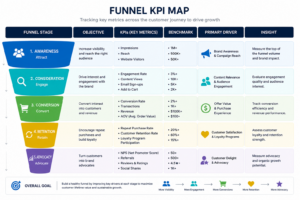
Sales funnel development key performance indicators, or KPIs, tell you whether your funnel is working or leaking. You do not need a dozen dashboards. A handful of clear numbers will guide nearly every decision you make:
Watch these numbers over time and let them point to your next improvement. If plenty of people visit but few sign up, your landing page or lead magnet needs work. If many sign up but few buy, your nurture sequence or offer needs attention. By reading these signals and adjusting one piece at a time, you build a funnel that grows steadily rather than one you rebuild from scratch every few months. The SBA marketing and sales guidance offers a helpful framework for setting goals and tracking progress as you go.
How long does Sales Funnel Development take?
A simple funnel with one offer, one lead magnet, and one email sequence can come together in a week or two of focused work. More elaborate systems with webinars or application steps take longer, but you do not need the full version to start earning. Launch a small slice, prove that the slice works, then expand.
Do I need expensive software or a sales funnel creator tool?
No. Many small business owners begin with an email platform, a simple landing page builder, and a payment processor they already use. A dedicated sales funnel creator tool can speed things up later, but the strategy matters far more than the software. Start with what you have and upgrade only when growth demands more.
What is the difference between a sales funnel and a website?
A website is a digital home that lets visitors browse freely in any direction. A funnel guides one specific person toward one specific action at each step. You can absolutely run both, and many funnels live inside a website, but a funnel removes distractions so the next move is obvious.
How do I know if my funnel is working?
Watch a few key numbers, such as how many visitors join your list, how many leads buy, and how much each customer is worth over time. When one number lags, you know which stage needs attention. Steady measurement beats guesswork every time.
What if I sell services instead of products?
Funnels work beautifully for service businesses. You can offer a free consultation as your lead magnet, use a short email sequence to build trust, and add an application step for higher-value engagements. The structure stays the same even when the offer is your time and expertise.
You now have a complete picture of how Sales Funnel Development turns scattered marketing into a calm, repeatable system. The path is straightforward when you take the steps in order: study what you already own, design a value ladder, generate leads at the top, teach and qualify in the middle, and nurture every relationship for the long haul. None of this requires a huge budget or a big team. What this requires is a willingness to map the journey and improve one stage at a time. Begin with a single offer this week, measure what happens, and let each small win fund the next. Your future customers are already looking for the result you provide, so give them a clear path to say yes.
Map your first funnel this week. Pick one offer, create one lead magnet, and write one welcome email, then watch what your numbers tell you. If you would like a partner to help you design a funnel that fits your business, reach out to the team at SalesTeach.com, and let us help you build a clear path from first hello to loyal customer.