
By Phil Preneur

Imagine a young girl setting up a lemonade stand on a warm Saturday morning at the corner of a neighborhood street.
The young entrepreneur creates a big yellow banner and prints a sign: “Fresh Lemonade 25¢.” A pitcher of lemonade sits on a small folding table. A paper cup tower stands ready.
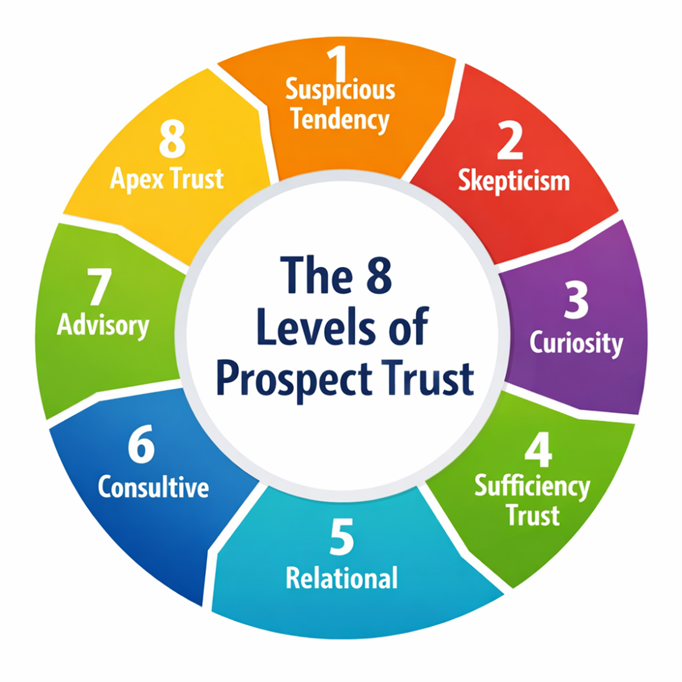
When the first passerby slows down, squints at the table, and thinks, “Kids selling lemonade sometimes use powdered mix or warm water, I will wait and see what customers say about the drink,” that is Prospect Trust Level One: The Suspicious Tendency.
Then two neighbors stop at the stand and react differently. The first neighbor smiles and asks, “Did you squeeze the lemons yourself? How much sugar did you add?” That neighbor demonstrates healthy skepticism, evaluating before buying.
The second neighbor waves a hand dismissively and says, “I am sure that lemonade is no good. Street lemonade always tastes terrible,” without asking any questions. That neighbor demonstrates toxic skepticism, rejecting without investigation. These two neighbors demonstrated the two facets of Prospect Trust Level Two: Skepticism
When a group of kids from down the block walk over and begin asking questions such as, “Is the lemonade sweet or sour?” and “Can you add extra ice?”, they express interest instead of doubt. That interaction represents Prospect Trust Level Three: Curiosity.
A jogger buys a cup, takes a sip, smiles, and says, “That actually tastes pretty good.” Another passerby hears the jogger and decides to try a cup. That stage represents Trust Level Four: Sufficiency Trust.
Several other neighbors begin stopping to chat with the young girl about school, summer plans, and mutual friends while buying lemonade. The interaction becomes personal rather than only transactional. They enjoy the conversation and lemonade. They become repeat customers and that represents Prospect Trust Level Five: Relational Trust.
A parent planning a party asks the girl, “I have 20 people invited to my home. How many pitchers would you make for an afternoon gathering?” the conversation shifts toward problem solving. That interaction demonstrates Prospect Trust Level Six: Consultative Trust.
People begin asking the young lemonade entrepreneur for suggestions such as, “We are visiting from out of town but love your lemonade and would like to make the same when we return home. Can you tell us how?” That moment represents Prospect Trust Level Seven: Advisory Trust.
When the next hot weekend arrives and families walk directly to the stand saying, “Let’s get lemonade from her because that stand always tastes best,” confidence has reached the highest level. People purchase without question or hesitation because experience has proven reliability repeatedly. That moment represents Prospect Trust Level Eight: Apex Trust.
“When you reach a high position of trust with your prospect, you no longer sell, you recommend.”
Trust determines whether prospects engage openly, share real concerns, and move toward decisions with confidence. Without trust, conversations remain guarded and transactional. With trust, resistance lowers and collaboration replaces persuasion. You are positioned. Building trust requires deliberate behavior rather than charm or persuasion tactics.
“Without trust… you ain’t selling anything.”


In person to person (or to people) sales, your prospect seldom starts in a position of neutrality. In fact, the first two levels of sales trust are ‘below zero.’
A suspicious mindset is in doubt.
Note: In marketing and prospect acquisition, I implement every method I can to condition prospects and position my business, product, service, salespeople, or myself to start an initial meeting on a higher rung on the eight levels of prospect trust. I have helped hundreds of entrepreneur clients do the same.
Prospect Trust Level One Mindset: “I don’t trust salespeople. You’re here to push something I don’t want or that costs too much.”
What do your prospects need to trust?
“Healthy skepticism is the sensible guardian of trust.”
Skepticism is the older sibling of suspicion. Skepticism has varying levels based on specific criteria. There is a fine line between suspicion and unhealthy skepticism. Toxic skepticism is an extreme form that can border on cynicism, causing a person to dismiss all information without proper or intelligent consideration. Skepticism Versus Toxic Skepticism
“People with healthy skepticism ask pertinent questions.”
“People with toxic skepticism generally make comments or ask rhetorical questions rather than making apposite inquires.”
Healthy skepticism is your best friend. You can navigate the questions and statements from this prospect and progress to the next level of trust.
Toxic skepticism is a minefield in a pig pen quagmire for a salesperson. You can bet stuck on this level and your sales process can blow up. If you are selling B2B, fortunately, toxic skepticism is not prevalent in most business target markets and industries.

Sales prospect curiosity marks a critical psychological shift in a conversation. A prospect who begins in skepticism has guarded posture, short responses, and surface-level engagement signal evaluation rather than openness. When curiosity emerges, that defensive posture starts to soften. The conversation moves from resistance to exploration.
Curiosity creates one of the most valuable windows for trust development. At this stage, a prospect has not fully agreed, yet has become willing to consider. That willingness allows a salesperson to guide thinking rather than push for decisions.
Pressuring your prospect in the skepticism or curiousity level prevents trust. Giving guidance during curiosity builds trust.
When you respond to curiosity with interest, thoughtful questions, clear explanations, relevant questions, and patience, your prospect begins to associate you and the interaction with clarity and safety rather than persuasion. This moment requires discipline. Many salespeople rush forward, interpreting curiosity as readiness to close. That mistake prevents and or erodes trust.
You can recognize curiosity through specific behavioral signals. Body language often becomes more relaxed such as uncrossing arms or relaxing posture or leaning slightly forward. Facial tension can soften and eye contact increases and holds longer.
Signs you look for:
Listening behavior also changes. A prospect who maybe once interrupted or did not respond begins to listen more intently.
Questions become the strongest indicator. Instead of defensive or dismissive questions, a prospect begins asking exploratory ones. Questions shift from skepticism to:
“How would this work in my situation?”
“What would this look like over time?”
“What is the warranty?”
Each of these signals indicates a transition from doubt toward consideration. When you respond correctly, the curiosity level can give you the opportunity to build genuine trust.
Sufficiency trust represents the tipping point where a sale can occur for some prospects. At this level, a prospect has enough confidence to move forward, even without deep relational connection or long-term advisory trust.
Many salespeople operate primarily at this level. They usually have below par conversion rates. I call this “Slam Bam Thank You Ma’am” selling.
A prospect reaches this level when three internal conditions align:
Minimal Trust
A prospect believes this salesperson or product or service can do the job. Adequacy is met and the risk feels manageable. These prospects might not trust the salesperson but believe enough in the product or service,
Solution Confidence
A prospect believes your offering represents an acceptable, and possibly the best, solution. Alternatives may exist, yet your option will suffice. The prospect might be in high need, desperate, short of time, or lack focus.
Acceptable Value
A prospect accepts that the value outweighs the risk. Price feels justified enough to proceed. Salespeople are often operating here are discounting to get sales.
A prospect does not need to feel deeply understood or fully aligned. A prospect simply needs enough certainty to justify movement. That explains why sales close at this level. Yet problems arise in these situations and limitations exist.
Sufficiency trust can produce faster decisions, yet price sensitivity can remain high. If a sales is made during this level, buyer’s remorse appears more frequently, returns or refunds happen more often, and loyalty is limited. Future sales or referrals are less.
Higher levels of trust create different outcomes. When a salesperson develops relational, consultive, or advisory trust, a prospect no longer evaluates only whether a solution works but begins to value your guidance, judgment, and long-term partnership. That shift increases deal size, reduces resistance, and strengthens retention.
One of the challenges is to know when a prospect has reached this minimum threshold level. Continuing to develop trust at a higher level is more valuable to business and the salesperson especially in high ticket sales and for most any relational development.

For most high-ticket selling and account representatives, relational trust represents the level required to win meaningful sales or business. Sufficiency may close smaller or transactional deals but larger commitments most always require more. Your prospect must feel understood, respected, and confident in both your intent and your judgment.
Relational trust often gets labeled as “rapport,” yet strong rapport goes beyond surface friendliness. Real connection forms through active listening, empathy, consistency, and emotional awareness. A prospect begins to think, “This person hears me, understands my situation and will guide me well.”
Relational trust can develop within a focused 45-minute conversation, over several weeks of dialogue, or longer depending on your window of opportunity and sales cycle. I have written scripts for high ticket sales that have developed intense emotional relationships in just 45 minutes after meeting for the first time. Then I put my money where my mouth is and sold the product or service with an 80% closing rate. That is what a great script and learning how to master the 8 levels of prospect trust can do.
At the relational level, your prospect shares more openly. They express questions, concerns, and constraints with greater clarity. That openness allows you to guide more precisely, which builds the relationship and trust.
1. Demonstrate Active Listening
Reflect key points back clearly to be certain you have heard both facts and concerns, not just surface statements.
2. Acknowledge Emotions and Context
Recognize your prospects uncertainty or past experiences. Validation builds connection faster than surface agreement.
3. Ask Thoughtful, Relevant Questions
Dig deeper and move beyond scripted discovery. Ask questions that show genuine curiosity about the prospect’s situation.
4. Maintain Consistency in Words and Actions
Follow through on every commitment. Small inconsistencies weaken trust quickly.
5. Match Energy and Communication Style
Adapt tone, pace, and formality to align with the prospect’s natural style without imitating.
6. Provide Clarity Without Overwhelming
Simplify complex ideas. Help the prospect think clearly rather than impress them with details.
7. Show Calm Confidence Without Pressure
Confidence reassures. Pressure creates resistance. Guide rather than push.
Relational trust creates stronger decisions, larger commitments, longer-lasting partnerships, and higher conversion rates.
Consultive trust develops when a prospect begins to rely on your expertise to solve a specific problem. At this level, you are no longer viewed as a provider of options. You are seen as a professional who can diagnose, recommend, and guide execution with precision.
Consultants earn trust through demonstrated proficiency. A prospect believes you understand the problem at a deeper level than internal teams or alternative vendors. That belief shifts the dynamic. Instead of evaluating features or pricing alone, a prospect evaluates your judgment.
Consultive trust centers on problem ownership.
A prospect thinks, “This person can figure this out and lead the solution.”
That mindset increases willingness to follow recommendations, accept structure, and move forward with clarity.
Diagnose Before Recommending
Ask structured, layered questions that uncover root causes rather than only symptoms. Show depth in how you think, not just what you know.
Frame the Problem Clearly
Define the your prospect’s issues in simple, cause-and-effect terms. When a prospect hears their situations explained better than they could describe their circumstances, their confidence in you increases immediately.
Offer Specific, Tailored Recommendations
Avoid generic advice. Connect each recommendation directly to the prospect’s conditions, constraints, and or goals.
Explain the “Why” Behind Your Approach
Tell your prospects what you would do and why. Walk through then through your reasoning. Transparency in your thought process builds credibility.
Demonstrate Pattern Recognition
Reference similar situations and outcomes. Show you have similar experience with your prospect’s challenges.
Lead the Process with Structure
Outline clear steps, timelines, and expectations. Lead with confidence.
Consultive trust positions you as a problem solver rather than a seller. You gain authority, get less objections, and get more sales.

Advisory trust is a higher level of confidence where your prospect relies on your judgment. At this stage, your role extends beyond solving a defined problem. You help shape direction, priorities, and outcomes. A prospect begins to think, “I want your perspective before I decide.”
You influence thinking at a strategic level here. Unlike a consultant who focuses on execution within a defined scope, an advisor helps define what should be done in the first place, the 10,000 foot view. Your value comes from experience, knowledge, perspective, pattern recognition, and the ability to anticipate consequences before they occur.
Advisory trust reduces your prospect’s or client’s decision anxiety. Your prospect no longer evaluates every option independently and trusts your guidance to filter choices, avoid mistakes, and move forward with confidence. That level of trust increases deal size, accelerates decisions, and strengthens long-term relationships.
Expand the Conversation Beyond the Immediate Problem
Discuss broader goals, risks, and problem symptoms. Discuss how the problem is affectiing them and then show awareness of the bigger picture.
Offer Perspective, Not Just Solutions
Share insights that reshape how your prospect sees a situation. Help your prospect think differently, not just act differently.
Challenge Assumptions Thoughtfully
Respectfully question flawed thinking or incomplete views. Strong advisors protect outcomes, not comfort.
Prioritize the Prospect’s Best Interest
Recommend against your own solution when appropriate. Integrity builds long-term influence.
Demonstrate Long-Term Thinking
Frame decisions in terms of future impact, not short-term gain.
Be Consistent and Selective with Advice
Avoid over-talking. When you speak, maitain consistency in subject matter as well as tone, energy, and volume.
Advisory trust positions you as a valued thinking partner. At this level, prospects cone to you for guidance and consider your recommendations.
Apex trust is the highest level of the 8 levels of prospect trust. I describe Apex trust as being like you would trust your mother… or whomever you might trust most in the world.
Apex trust is when people act without hesitation. They have no doubts or concerns.
This is a trust level unique to each person’s ultimate trust capability and not usually achievable for prospects in high ticket sales or without long term relationships.
So why include Apex trust in sales at all?
Because I aim for the highest level, the apex, in most anything I do. After all, you will seldom hit the bullseye or even close if you are not aiming there.