
Phil Preneur

If you want to know how to close sales consistently at a high conversion rate, begin with an uncomfortable realization that many salespeople spend years avoiding:
Your psychology enters every sales conversation long before your pitch does.
Most salespeople searching for how to close sales assume weak closing rates come from poor scripts, weak rebuttals, pricing objections, lead quality, or presentation structure. Those factors matter.
Yet beneath surface mechanics, another layer quietly shapes nearly every sales outcome. Emotional regulation, insecurity, conversational pressure, psychological neediness, ego attachment, emotional triggers, and behavioral awareness often determine whether another person trusts you enough to buy.
Experienced salespeople eventually recognize a pattern that beginners rarely see clearly. Prospects usually react less to memorized words and more to emotional atmosphere, conversational questions and responses, trust signals, emotional congruence, certainty calibration, and perceived intent.
That distinction changes everything.
Two salespeople may present the same product, same pricing, same offer structure, and same financing options. One creates trust, emotional safety, and forward movement. The other creates resistance, hesitation, emotional discomfort, or silent distrust. Technical product or service knowledge alone does not sustain a satisfactory closing rate.
Saleschology makes the difference.
Many salespeople unknowingly carry fear, insecurity, emotional dependency on outcomes, rejection sensitivity, or approval seeking behavior into conversations. Under pressure, those emotional patterns quietly leak into tone, pacing, body language, objection handling, listening behavior, interruption timing, and conversational control attempts.
The prospect usually feels those patterns before consciously identifying them.
That reality explains why learning how to close sales requires far more than learning closing techniques. Strong sales ability often grows from emotional awareness, behavioral observation, communication discipline, psychological restraint, and understanding how emotional dynamics shape trust.

One of the most common psychological weaknesses affecting how to close sales involves emotional dependency on validation.
That pattern creates subtle desperation inside conversations.
A salesperson emotionally attached to approval often changes behavior rapidly when sensing uncertainty from the prospect. Tone becomes less natural. Explanations become longer. Agreement seeking increases. Humor becomes forced. Conversational pacing speeds up. Objections begin feeling emotionally threatening instead of informational.
Most prospects never verbally identify those shifts. They simply begin feeling less comfortable psychologically.
Salespeople frequently misunderstand desperation because desperation does not always appear dramatic. Sometimes desperation sounds overly polite, overly accommodating, excessively enthusiastic, unnaturally agreeable, or emotionally eager for reassurance.
Emotionally grounded salespeople usually behave differently. Calm curiosity remains present even when uncertainty appears. Listening continues. Emotional pacing remains controlled. Silence no longer creates panic. Objections become information rather than emotional rejection.
For example, imagine presenting a high ticket offer during a Zoom meeting. After discussing pricing, the prospect pauses and says, “I need to think about this.”
An emotionally reactive salesperson often experiences immediate internal anxiety. That anxiety usually creates behavioral leakage. Pressure increases subtly. Over explaining begins. Urgency language suddenly appears. Discounts emerge prematurely. Emotional control decreases because identity now feels attached to the outcome.
An emotionally grounded salesperson studying how to close sales often studies the hesitation instead of emotionally reacting to the hesitation.
That difference matters enormously.
Learning how to close sales requires awareness of your emotional state during uncertainty because uncertainty magnifies underlying psychology rapidly.
Most salespeople focus heavily on what to say while ignoring how emotional patterns for how they should be talking.
Conversation mechanics reveal opportunities and weaknesses constantly.
Interruption frequency, pacing, voice modulation, question timing, silence tolerance, eye contact, emotional congruence, and reaction speed often communicate more than scripted language. Prospects unconsciously study those signals from you throughout the interaction.
Experienced behavioral strategists frequently identify struggling salespeople before hearing the actual offer. Emotional patterns usually emerge quickly through conversational structure alone.
For example, insecure salespeople often rush transitions because silence causes them discomfort. Salespeople answer objections before fully hearing them because uncertainty creates anxiety. They speak with excessive certainty because internal insecurity requires overcompensation.
Strong sales communication usually sounds psychologically regulated rather than performative.
Understanding how to close sales requires more than polished talking points. Observation quality increases dramatically once emotional self protection decreases. You begin noticing hesitation patterns, emotional inconsistencies, contradiction language, avoidance behavior, emotional shifts, and unspoken concerns more accurately.
Many prospects never verbally explain the real reason behind hesitation. Emotional information often appears indirectly through pacing changes, emotional withdrawal, contradiction patterns, defensive humor, vagueness, or sudden topic shifts.
A psychologically aware salesperson learning how to close sales observes those patterns calmly instead of forcing scripted momentum mechanically.
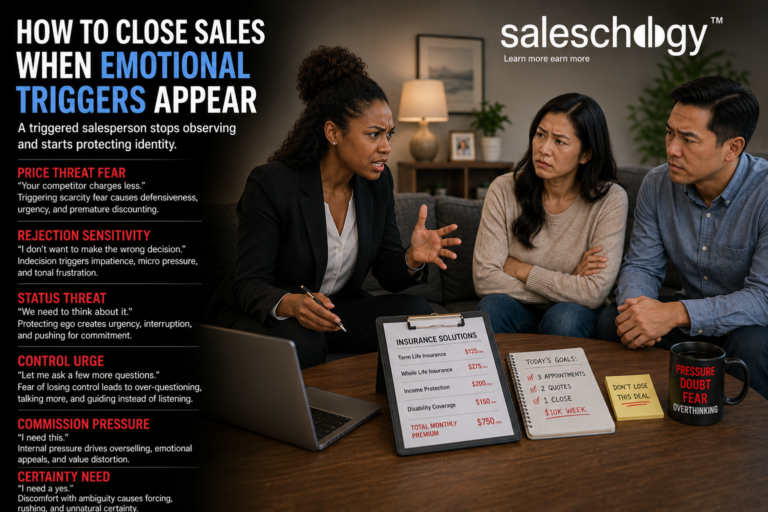
A triggered salesperson stops observing and starts protecting identity.
Once that shift occurs, sales quality usually declines rapidly.
For example, imagine hearing the phrase, “Your competitor charges less.” If scarcity fear strongly affects your psychology, emotional pressure may quietly enter your nervous system immediately. Tone changes slightly. Emotional urgency increases. Defensiveness appears beneath professionalism.
Without awareness, you may begin overselling value, lowering price prematurely, criticizing competitors emotionally, or forcing certainty unnaturally.
Another salesperson may feel triggered by indecisive prospects because rejection sensitivity creates emotional impatience. Once hesitation appears, emotional tension increases internally. That tension eventually leaks through pacing, micro pressure, tonal frustration, interruption patterns, or passive aggressive language.
Prospects usually detect emotional incongruence quickly even when they cannot explain why.
According to Harvard Business Review research, self awareness strongly affects emotional regulation, communication quality, trust, and leadership effectiveness. Harvard Business Review on self awareness
Learning how to close sales requires emotional regulation because sales conversations magnify fear, uncertainty, status concerns, commission pressure, and emotional attachment simultaneously.
That emotional pressure exposes hidden weaknesses quickly.
1. Slow the Conversation Before You Try to Control the Conversation
Many triggered salespeople instinctively increase conversational speed. Talking accelerates. Pressure increases. Explanations become longer. Questions become more aggressive. That reaction usually comes from internal anxiety rather than strategic communication.
When emotional triggers appear, intentionally slow your pacing. Lower your voice slightly. Pause before responding. Allow silence to exist without rushing to fill every gap.
A calmer pace gives your nervous system time to regain regulation. More importantly, slower pacing allows observation to return. Once observation returns, emotional intelligence usually improves immediately.
A prospect saying, “Your competitor charges less,” does not automatically require defense. The statement may simply reflect uncertainty, negotiation behavior, risk management, or a request for clarification.
Emotionally regulated salespeople study emotional meaning before reacting mechanically.
2. Separate the Objection From Your Identity
Triggered salespeople often personalize objections unconsciously.
A pricing objection may feel like rejection. Hesitation may feel like distrust. Delayed decisions may feel like failure. Once identity becomes emotionally attached to the outcome, defensive behavior usually appears automatically.
Strong salespeople mentally separate:
That psychological separation changes emotional behavior dramatically.
Instead of internally hearing:
“They do not believe in me.”
You begin hearing:
“They still need emotional certainty.”
That reframing keeps your nervous system calmer and preserves conversational objectivity.
3. Study the Emotional Pattern Instead of Reacting to the Emotional Pattern
Most emotionally reactive salespeople focus on eliminating discomfort quickly. Strong behavioral salespeople become curious about discomfort instead.
For example, hesitation often contains emotional information:
Once you begin studying emotional structure instead of fighting resistance emotionally, your communication becomes more precise and less manipulative.
A calm observational mindset often sounds like:
“Help me understand which part feels uncertain right now.”
That response gathers emotional intelligence instead of escalating emotional pressure.
4. Recognize Your Personal Trigger Patterns Early
Every salesperson usually carries predictable emotional triggers.
Some become emotionally reactive around pricing objections. Others react strongly to indecision, skepticism, silence, comparison shopping, authority challenges, or emotional withdrawal.
Strong salespeople identify patterns before entering conversations.
For example:
Once awareness develops early, emotional regulation becomes far easier because triggers stop operating invisibly.
Behavior that remains unconscious usually remains automatic.
5. Stop Trying to “Win” the Conversation
Triggered salespeople often shift from understanding the prospect to defeating resistance psychologically.
That shift changes tone immediately.
Listening decreases. Curiosity disappears. Emotional pressure increases. The salesperson begins protecting certainty instead of discovering truth.
Strong salespeople recognize that emotionally forcing agreement usually weakens trust.
Many prospects do not need more persuasion. Many prospects need reduced emotional pressure.
The moment you stop trying to overpower hesitation emotionally, conversations often become calmer, more honest, and more productive.
Sales conversations improve dramatically once emotional combat disappears.
6. Use Questions to Regain Emotional Neutrality
Emotionally triggered salespeople usually talk too much.
Questions restore observation.
When emotional tension rises internally, move back into thoughtful diagnostic questions instead of persuasive monologues.
For example:
Questions shift your nervous system away from defensive performance and back toward curiosity and information gathering.
That transition reduces emotional urgency while improving trust simultaneously.
7. Review Your Emotional Reactions After Every Important Sales Call
Most salespeople review outcomes. Strong salespeople review psychology.
After emotionally difficult calls, evaluate:
That level of self observation creates long term behavioral refinement.
Many emotional reactions feel invisible during live conversations. Patterns become easier to recognize afterward.
Over time, emotional triggers lose power because awareness interrupts automatic reactions earlier and earlier.
That process represents one of the hidden psychological foundations behind learning how to close sales consistently without sounding desperate, defensive, manipulative, or emotionally reactive.
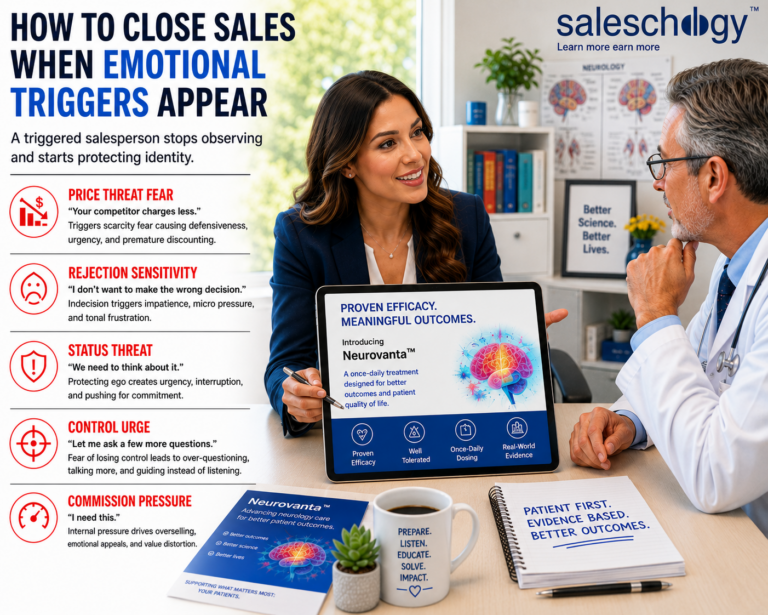
Unresolved insecurity rarely remains hidden during long term sales careers.
Insecurity usually leaks through over talking, control patterns, emotional defensiveness, excessive certainty, argumentativeness, premature closing attempts, validation seeking, or inability to tolerate objections calmly.
Some salespeople unconsciously use dominance to hide insecurity. Others use excessive friendliness. Another may become emotionally dependent on high closing percentages because identity now revolves around performance validation.
Those patterns create distorted sales behavior over time.
For example, insecurity often causes salespeople to confuse pressure with leadership. Once emotional attachment to the sale increases, conversational manipulation frequently increases alongside that attachment.
You may begin interrupting more often. Emotional pacing may accelerate. Questions become less curious and more controlling. Listening decreases because emotional self protection becomes more important than accurate observation.
Strong salespeople usually maintain psychological separation between personal worth and sales outcomes.
That separation creates emotional freedom during conversations. Calmness increases. Listening improves. Observation sharpens. Objections lose emotional power because rejection no longer feels identity threatening.
Many professionals learning how to close sales underestimate how strongly insecurity affects tone, pacing, pressure, and emotional congruence.
Learning how to close sales requires emotional discipline strong enough to remain psychologically stable regardless of immediate outcomes.
Psychological selling does not mean manipulation.
Psychological selling means understanding emotional behavior, decision making patterns, trust formation, fear responses, identity protection, and communication dynamics accurately.
Strong salespeople observe emotional structure beneath surface language.
For example, a prospect may repeatedly discuss pricing while actually fearing regret, embarrassment, uncertainty, implementation failure, social judgment, or loss of control. Another may claim timing concerns while emotionally struggling with trust. Another may intellectualize every detail because emotional certainty feels psychologically necessary before action.
Surface objections frequently hide deeper emotional mechanics.
Strong salespeople learn how to separate stated objections from emotional reality.
That skill changes closing ability dramatically because emotionally accurate communication creates trust more effectively than memorized rebuttals.
The National Institutes of Health explains how cognitive biases shape judgment and decision making. National Institutes of Health cognitive bias research
Prospects carry biases into sales conversations constantly. So do salespeople.
For example, confirmation bias may cause you to hear only information supporting your assumptions about the prospect. Projection bias may cause you to assume another person shares your emotional motivations, risk tolerance, urgency level, or priorities.
Once assumptions replace observation, sales accuracy declines.
Understanding how to close sales requires accurate emotional observation rather than scripted conversational force.
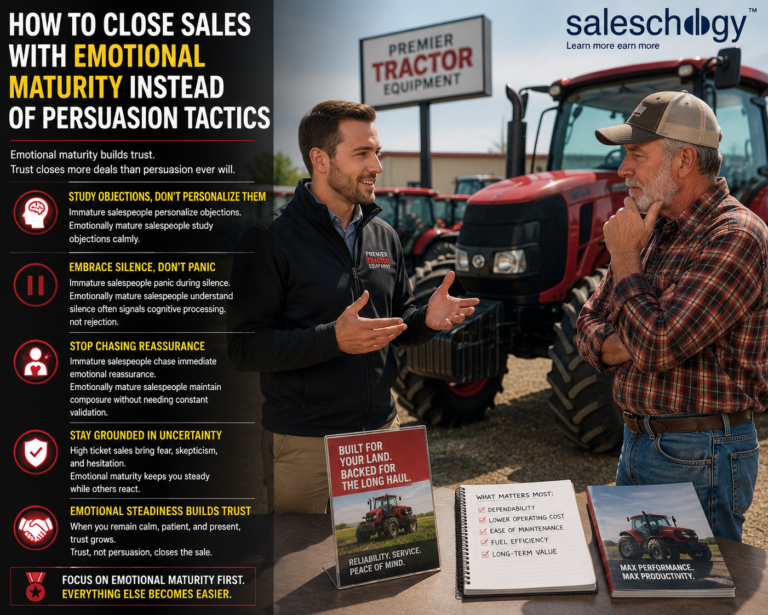
Many charismatic salespeople struggle with long term trust because emotional maturity remains underdeveloped beneath polished communication.
Emotional maturity affects objection handling, emotional restraint, pressure regulation, accountability, patience, emotional stability, and honesty during uncertainty.
Immature salespeople often personalize objections. Emotionally mature salespeople study objections calmly.
Immature salespeople frequently panic during silence. Emotionally mature salespeople understand silence often signals cognitive processing rather than rejection.
Immature salespeople chase immediate emotional reassurance. Emotionally mature salespeople maintain composure without requiring constant validation from the prospect.
That distinction becomes especially important during high ticket sales environments where uncertainty, fear, skepticism, and emotional risk naturally increase.
A mature salesperson can remain psychologically grounded even while another person hesitates, questions credibility, challenges assumptions, or delays decisions.
That emotional steadiness quietly increases trust.
Many individuals searching for how to close sales focus heavily on persuasion techniques while ignoring emotional maturity completely.
Many salespeople evaluate performance almost entirely through numbers. Revenue matters. Closing percentages matter. Yet behavioral self assessment often reveals why performance changes in the first place.
You should regularly evaluate:
Those behaviors expose hidden psychological patterns affecting sales outcomes daily.
For example, many salespeople assume weak closing ability comes from insufficient aggression. Sometimes the opposite problem exists. Emotional pressure may already feel too high throughout the conversation because insecurity quietly drives excessive control behavior.
Another salesperson may struggle because conflict avoidance prevents difficult conversations around budget, authority, urgency, or consequences.
Behavioral awareness allows precise improvement because awareness identifies the real mechanism underneath performance problems.
Salespeople seriously studying how to close sales often improve rapidly once behavioral awareness increases.
Most high level salespeople developed through painful self observation rather than motivational excitement alone.
Growth usually begins once you stop protecting identity and start studying behavior objectively.
Call recordings help enormously because recordings expose patterns invisible during live conversations. Many salespeople become shocked after hearing their pacing, interruption frequency, nervous laughter, tonal pressure, filler language, or conversational control habits objectively.
Journaling after difficult sales conversations also improves awareness significantly. Instead of asking only whether the sale closed, ask deeper questions:
Questions like these strengthen psychological discipline over time.
Therapy, emotional intelligence training, negotiation training, communication coaching, meditation, leadership development, and behavioral psychology education can all improve sales performance because sales ultimately involves human behavior under uncertainty.
Understanding how to close sales becomes much easier once you identify the emotional patterns quietly affecting your conversations.
How to close sales requires much more than memorizing scripts, handling objections, or learning persuasive phrases. Your emotional patterns, insecurities, biases, communication habits, maturity level, and psychological regulation quietly shape every interaction you have with a prospect.
Strong sales ability usually emerges from emotional awareness combined with behavioral discipline. Once you understand how fear, insecurity, validation seeking, emotional triggers, and conversational pressure affect your behavior, your ability to build trust and influence decisions improves dramatically.
Many salespeople spend years trying to control the prospect while never learning how to control their own emotional reactions first.
That mistake quietly destroys more sales than weak scripts ever will.
Learning how to close sales consistently often begins with psychological honesty about your own behavior first.
Can insecurity hurt your ability to close sales?
Yes. Insecurity often creates desperation, over explaining, emotional defensiveness, pressure based behavior, approval seeking, and poor listening habits. Many professionals trying to learn how to close sales underestimate how visible insecurity becomes during uncertainty.
Why do emotional triggers matter when learning how to close sales?
Emotional triggers affect observation quality, communication, pacing, patience, objection handling, and emotional regulation during uncertainty. A triggered salesperson usually reacts emotionally instead of observing accurately.
What causes prospects to distrust salespeople quickly?
Prospects often react negatively to emotional incongruence, pressure, manipulation, defensiveness, excessive certainty, poor listening, or desperation.
Does psychological selling help you learn how to close sales?
Yes. Psychological selling helps you understand emotional behavior, trust formation, communication dynamics, hesitation patterns, and decision making psychology more accurately.
Why do some salespeople stay calm during objections?
Emotionally grounded salespeople separate personal worth from sales outcomes. That separation allows calm observation instead of emotional reaction.
What is Saleschology?
Saleschology is a word first coined in 1998 by Philip Baker. Saleschology is the study and application of psychology to sales and selling.