
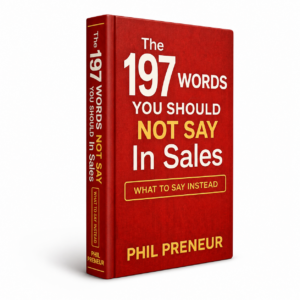
The 197 Words You Should Not Say in Sales by Phil Preneur is a warning to sales professionals: language alone can quietly destroy deals long before a prospect ever says “no.”
Built on the analysis of thousands of recorded sales calls and Zoom meetings across 112 industries ranging from small businesses to Fortune 500 environments, The 197 Words You Should Not Say in Sales exposes a hidden layer of sales failure that most professionals never diagnose.
The 197 Words You Should Not Say in Sales is based on a simple but powerful premise: many sales are lost not because of price, product, or timing, but because of specific words and phrases that trigger distrust, confusion, or resistance. Phil Preneur presents that salespeople often walk away from lost opportunities without understanding that their own language sabotaged the sale. In some cases, as little as one word can cause a loss of credibility and ultimately derail the decision process.
The book exposes 197 commonly used words and phrases that should be eliminated from sales conversations. Each example highlights how seemingly harmless language can produce negative psychological reactions. Some terms signal self-interest or agenda, making the salesperson appear more focused on closing a deal than helping a prospect. Others create the impression of low intelligence, lack of preparation, or weak understanding of the buyer’s situation. Certain phrases come across as vague or abstract, forcing the prospect to work harder to interpret meaning, an effort most buyers resist. Still others unintentionally sound manipulative, deceptive, or even insulting.
A major theme throughout the book involves trust erosion. Preneur explains that trust rarely collapses in a single moment; instead, trust degrades incrementally through repeated exposure to poor language choices. Words that lack clarity, ownership, or specificity can make a salesperson seem out of touch or disengaged.
The 197 Words You Should Not Use in Sales exposes language that implies assumptions or shortcuts that can make prospects feel misunderstood. Even common business jargon, often used to sound professional, can have the opposite effect by creating distance and signaling insincerity.
The book also connects language to cognitive bias. Certain phrases can reinforce biases within both the salesperson and the buyer, leading conversations in unproductive directions. By using imprecise or loaded language, salespeople may unintentionally trigger skepticism, defensiveness, or hesitation. Preneur emphasizes that controlling language means protecting the psychological environment of the sale.
An example of one of the worst offenders:
“When someone says, ‘to be honest’ I wonder what their criteria is ‘To be or not to be.” – Phil Preneur
This phrase suggests that your previous statements may not have been honest. Prospects might also question why honesty needs to be announced at all.
If you say this, please do everything you can to stop. Communicate consistently and clearly from the beginning without signaling a shift in truthfulness. Consistency moves you up the 8 levels of prospect trust more effectively than disclaimers. Direct communication is more credible.
What to Say Instead:
“As a matter of fact…”
“In fact, we have built a great reputation for our work and service as shown by our 5 star Google rating more than 77 positive Google reviews.”
“The data shows that…”
“What I would do if I woke up in your shoes is….”
“If you were my sister I would tell you…”
“The facts we have substantiated are…”
“I am hearing what matters the most to you is…”
“I am going to be direct with you because I care.”
Another example entry:
Saying “advance the initiative” can weaken clarity and create distance because the phrase is abstract and classifies as jargon. Prospects might not immediately understand what action is being proposed, which can slow momentum and require additional clarification.
Instead of communicating progress, this language can feel like corporate filler that lacks tangible meaning.
The phrase can also sound impersonal. Referring to a decision as an “initiative” can make the conversation feel detached from the prospect’s real goals, priorities, and outcomes.
“Advance the initiative” does not define what happens next, which can create ambiguity around expectations.
Prospects respond more positively to language that directly connects to their situation rather than generalized terminology. High-trust selling uses clear, human-centered communication that reflects real actions and results.
“Let’s outline the next steps to move this forward effectively.”
“Here’s what we can do next to achieve your goals.”
“I’ll walk you through the next actions, so everything is clear.”
________________________________________________________________
Beyond diagnosis, the book positions itself as a practical correction tool. Readers are encouraged to remove these 197 words from scripts, calls, meetings, and presentations, replacing them with language that is clear, grounded, and aligned with the prospect’s perspective. The focus remains on eliminating friction rather than adding persuasion tactics.
The result, according to reported outcomes, can be dramatic. Sales professionals who refined their language using these principles have experienced conversion rate increases of more than two times. In high-ticket sales environments, even modest improvements translate into significant revenue gains.
Ultimately, ‘The 197 Words You Should Not Say in Sales’ reframes communication as a precision skill. Success depends not only on listening and responding to prospects, but what a salesperson says and does not say.

Get your copy of The 197 Words You Should Not Say in Sales at Amazon and stop losing sales now.