
By Phil Preneur
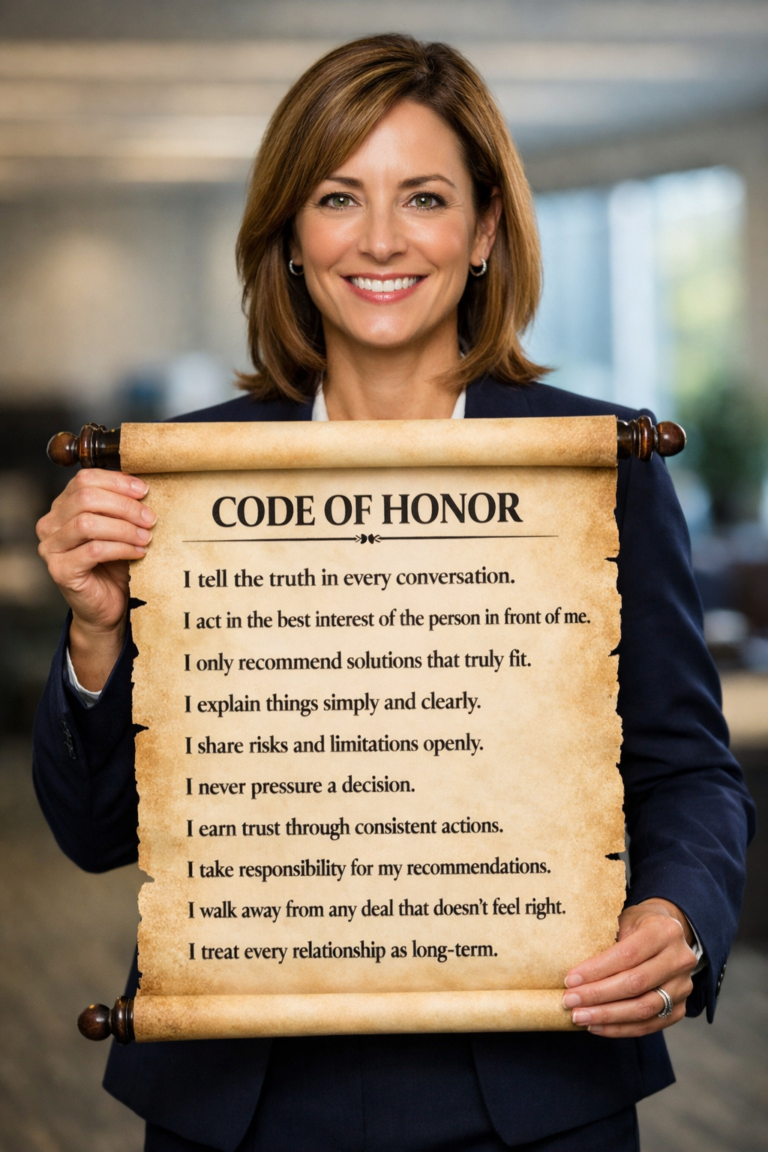
“You are most likely to compromise your integrity or breach your boundaries when they are not well established and announced commitments.” – Phil Preneur
A sales code of honor or credo is a standard for behavior that you define and adhere to, or your business defines and adherence is expected of your salespeople.
Synonyms include:
Salespeople often know how to say the right things and can follow a script. People (prospects know this.) How can your prospects gain assurance and trust that you do the right things?
The first step to becoming a salesperson or starting a sales career is creating your Sales Code of Honor. However, you are never too late to do this now.
Salespeople often have widely varying and loosely defined ethics. Many think as long as I am not ripping off prospects or a dishonest statement I’ve made is not deteceted everything is fine.
Without an established set of beliefs that guide ethical sales behavior, you are left to an ethical sliding scale that can vary in sometimes complex situations.
Most salespeople have at one time crossed their personal ethical boundaries and justified their action for example by calling that a “white lie” or by saying “well nobody got hurt.” Sometimes prospects are hurt and the salesperson’s reputation is damaged.
Maybe a salesperson makes a hollow promise when a prospect asks for something unrealistic, a timeline is impossible, or a simple shortcut could push a sale across the finish line. These moments can define a career.
You can take control to stop any temptation that might arise when you develop and live by a sales code of honor.

Merchants in medieval markets followed a trade or sales code of honor. Honest weights, fair dealing, and honoring agreements were expected. Reputation determined survival, so integrity became a business necessity.
In Japan, samurai followed Bushido. Bushido was not a suggestion. Bushido laid out a clear set of expectations. A samurai was expected to act with rectitude, meaning doing what is right without hesitation. Courage was required, not just in battle but in everyday decisions. Compassion mattered. Respect mattered. Honesty mattered. Honor and loyalty were not optional traits. A samurai who failed those standards lost standing, not just externally but internally.
In medieval Europe, knights followed a code of chivalry. That code required protection of the weak, loyalty to a cause, courage in the face of danger, and a refusal to lie or betray. Courtesy and respect were not surface level behaviors. Those qualities defined how a knight operated in every interaction.
In ancient Greece, physicians followed what is now known as the Hippocratic Oath. A physician committed to acting for the benefit of the patient, avoiding harm, keeping information confidential, and refusing to exploit a situation for personal gain. That code still influences modern medicine for a reason.
Roman soldiers took an oath called the Sacramentum. That oath required obedience to command, refusal to desert, and acceptance of punishment if standards were violated. Discipline was not negotiable. Consistency built strength across the entire unit.

Johnson and Johnson still operates from a written credo that clearly states responsibility to patients and customers will come first, before profit.
Patagonia built an entire company around a mission to protect the environment, even when that decision costs money.
Navy SEALs operate under a stated ethos that includes never quitting, leading by example, and treating a word as a bond.
Toyota built a system based on continuous improvement and respect for people, which shows up in daily operations, not just statements.
Warren Buffett built a career around protecting reputation, staying within areas of understanding, and walking away from deals that do not make sense.
Every one of those examples shares the same idea; establishing and adhering to standards that guide behavior. In sales, the same approach applies.
Without a sales code of honor, behavior can shift depending on your deal. With an established sales code of honor that you follow, your behavior stays consistent no matter who sits across the table or is on the call or screen, and the situation. That consistency becomes noticeable. Prospects recognize and give trust to consistency and direct answers.
A sales code of honor gives you confidence and energy in sales. Internal conflict can drain your energy. Your preestablished behavior guard rails prevent any gray areas.
A sale code of honor does not make you perfect but predictable in the best way possible and that build trust.
A sales code of honor does not come from copying another company or repeating generic values. A code of honor comes from deciding, ahead of time, your values and how situations will be handled.
Start with a simple question: What role do I actually play?
While you might start with something like selling services or selling software those are surface level. A more accurate description might sound like helping a business owner decide with clarity or helping someone avoid a costly mistake. That framing matters because a code of honor needs to align with a real function.
Examples:
I advise businesses about accounting software and services and help them find the best solutions.
I help people make the best choices for painting their home.
I am a business hero and help protect owners with the right insurance.
Once your role is clear, the next step is deciding what standards will guide your behavior.
Here are my standards for ‘The 12 Commiments of Sales’
A commitment to long-term relationships means approaching every new conversation as the beginning of an ongoing partnership, not a one-time opportunity to close.
A commitment to truth means answering questions directly and honestly, even when a transparent answer may reduce immediate momentum.
A commitment to the prospect’s best interest means filtering every recommendation through what benefits the client—not what benefits commission, quota, or convenience.
A commitment to fit means recommending a solution only when a situation clearly justifies that solution, and withholding recommendations when alignment does not exist.
A commitment to clarity means explaining ideas, options, and outcomes in a way that is simple, direct, and easy to understand—without hiding behind complexity or jargon.
A commitment to listening means giving full attention, seeking to understand before responding, and asking clarifying questions rather than making assumptions.
A commitment to autonomy means allowing the prospect to think, evaluate, and decide at their own pace—without pressure, manipulation, or forced urgency.
A commitment to transparency means openly sharing risks, downsides, trade-offs, and limitations before any decision is made.
A commitment to ethical influence means refusing to use manipulative tactics, hidden agendas, or persuasion techniques designed to override sound judgment.
A commitment to trust-building behavior means earning trust through consistent honesty, respect, and alignment—not through tactics, scripts, or performance.
A commitment to responsibility means standing behind every recommendation made and owning the outcomes that follow.
A commitment to discernment means walking away from opportunities that do not make sense for the prospect, even when a sale is possible.
Those are not statements meant to sound good. Those are decisions about how to act when pressure exists.
Then define what will not be done. A real code of honor draws lines.
Those boundaries matter because pressure tends to create rationalization. Without a clear line, almost anything can be justified in the moment.
A written version helps. Not for show, but for clarity. Simple language works best. If a sentence cannot be said out loud in a normal conversation, that sentence probably does not belong in a code of honor.
Get The 12 Commitment template
to create your personal Sales Code of Honor
FREE INSTANT DOWNLOAD CLICK HERE
I will share my personal Sales Code of Honor here:
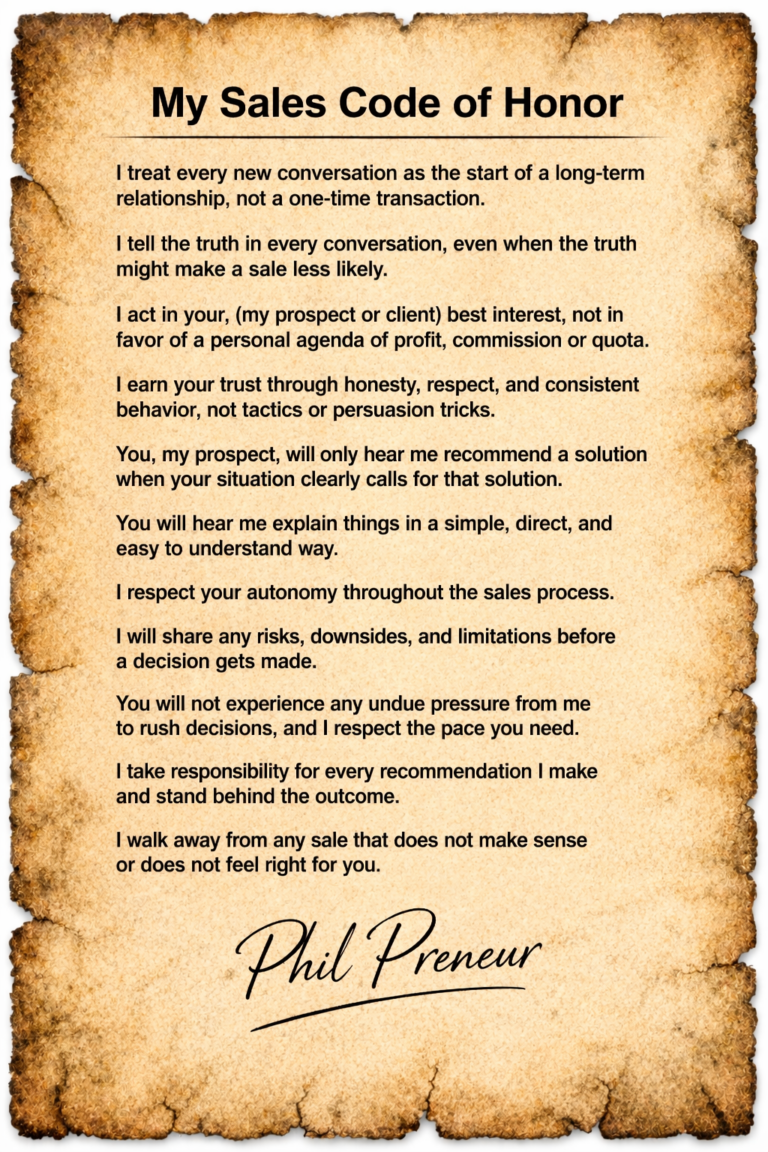

The primary purpose of your sales code of honor is for your internal guidance. A code guides behavior and your consistent behavior creates a pattern and over time, people recognize your pattern.
Sharing your sales code of honor establishes your ethics with prospects.
A simple page on a website can explain how work gets done. Just a straightforward explanation of how decisions are approached and how conversations are handled.
Email introductions are another natural place. A brief note explaining your sales code of honor or a link can position you for trust before you even meet prospects.
Appointment confirmations can do the same thing. Letting someone know that a conversation will focus on understanding a situation without any obligation reduces tension.
During a live conversation, your code can be stated simply and naturally. A sentence that explains a goal of understanding what is going on and being honest about whether something makes sense shifts the dynamic immediately. The conversation becomes collaborative instead of guarded.
An About page can reinforce the same idea. Not just background or credentials, but how work actually gets done.
A sales code of honor is not something that needs to be announced repeatedly. Your sales code of honor shows up the same way, every time, across every interaction.
Your sales code of honor needs to move from ideas into habitual behavior. I hang a copy of mine where I can see my resolutions every morning.
Telling the truth becomes answering questions directly. Recommending what fits becomes saying that something does not make sense when that is the case. Taking responsibility becomes owning the outcome connected to a recommendation.
From there, real conversations become the testing ground. Situations will come up that expose gaps. Adjustments happen. Over time, your responses become automatic.
Thank you,
Phil Preneur